Why it Matters What Paint you Put on your Walls
The Crucial Link: Breathability, Damp and Building Physics
Older buildings were usually built to breathe: lime mortars, porous bricks and lime plasters allow water vapour to move through the fabric so moisture can evaporate outside or to internally ventilated spaces. Modern paints with plastic or oil binders (low-permeability acrylics, masonry paints and some emulsions) can form a vapour barrier. That stops moisture escaping, so damp becomes trapped inside the wall, leading to flaking, salt bloom, mould and long-term decay of plaster and masonry. The moisture has to go somewhere. For heritage substrates, choosing a breathable finish that permits vapour transmission is therefore a primer for long-term preservation.
Many conventional petroleum-derived paints release volatile organic compounds (VOCs) during application and curing. Short-term exposure can irritate eyes, nose and throat; long-term or repeated exposure is linked to respiratory problems and other systemic effects. From an environmental perspective, synthetic binders are fossil-fuel derived and their lifecycle (production, solvent use, disposal) carries a higher carbon and pollution footprint than many natural or mineral alternatives. Choosing low- or zero-VOC and mineral/natural paints reduces indoor pollutants and typically lowers embodied-carbon and toxic solvent use.
The Benefits of Eco-Friendly/ Breathable Paints
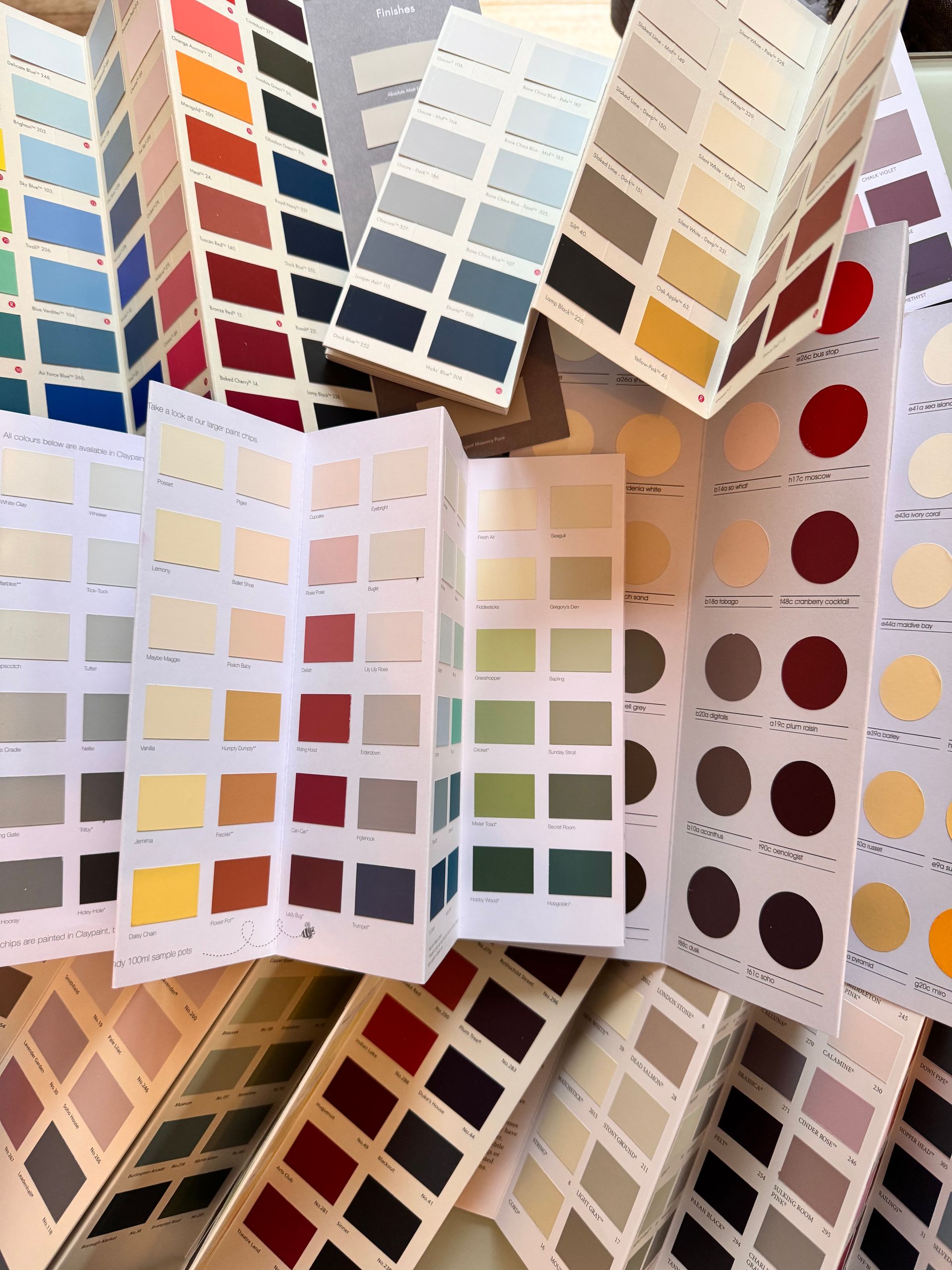
Breathable, traditional or “eco” paints (limewash, clay paints, mineral silicate paints and plant-based emulsions) offer several practical benefits for heritage properties:
- Allow moisture to escape: compatible with lime plaster and solid walls, reducing trapped moisture and mould risk.
- Low or negligible VOCs: better indoor air quality for occupants.
- Durability on the right substrate: mineral silicate paints chemically bond to mineral surfaces and are very long lived; natural paints can be more repairable and easier to recoat sympathetically.
- A smaller environmental footprint: many are plant, earth or mineral based rather than petroleum-derived.
These advantages make such paints a sensible first choice for lime-plastered rooms, solid brick walls and other traditional substrates.
The Disadvantages of Modern Petroleum-Derived Paints
Modern acrylic and many masonry paints do have benefits (cheap, fast drying, high opacity), but on historic buildings they can cause problems:
- Low vapour permeability: they can trap moisture behind the coating and cause plaster failure.
- Higher VOC emissions (especially older formulations): short-term odour and indoor air quality issues.
- Difficult to reverse: many modern coatings strongly adhere to substrates, making future paint removal or restoration harder and more invasive.
For a heritage project, the “quick and cheap” paint can create expensive repair work later, and it also masks authentic finishes.
How to Tell Whether you Existing Paint is Petroleum-Derived
If you suspect a modern paint has been used, here are simple checks you can do before major work:
- The rubbing-alcohol / acetone test: moisten a cotton ball with isopropyl alcohol (or acetone for a stronger test) and rub an inconspicuous area. If paint softens or comes off easily it’s likely water-based (latex/acrylic). If it resists and stays hard it’s likely oil-based or a strong synthetic coating. (Always test in a discreet place and wear gloves/ventilate.)
- Look at the sheen and feel: plastic masonry paints and acrylic emulsions often have a smoother, slightly plasticky surface; breathable natural paints (limewash, clay) feel matt and more mineral/velvety. However, it is often difficult to tell with modern flat matt paints.
- Check product labels or datasheets: if you can trace what was used (leftover tins, decorator’s invoice), technical data sheets reveal binder type and VOC content. Manufacturers will state whether a paint is mineral/silicate, clay or acrylic.
If in doubt, commission a small professional analysis. Conservators and heritage painters can identify coatings without harming the substrate.
What to do with Petroleum-Deprived Paint on a Heritage Wall
- Don’t panic, assess: If the coating is sound and there’s no rising damp or flaking underneath, you may be able to plan a staged remediation rather than immediate full removal.
- Prioritise the fabric: If damp or trapped moisture is evident, breathable finishes should be introduced as part of a fabric-first repair (improve drainage, fix leak paths, then address coatings).
- Test small removals first: Mechanical, hot-water/steam and controlled chemical stripping are techniques used to remove plastic/static masonry paints; choose methods that won’t drive salts or caustic residues into lime plaster. Specialist conservators can advise which method suits the substrate.
- If removal isn’t possible immediately: Avoid sealing the surface with further impermeable layers. Instead consider reversible, breathable solutions (limewash or sacrificial mineral finishes) after appropriate preparation. This can only be a temporary as the layer beneath is still not breathable.
- Engage a heritage decorator or surveyor: They’ll test, specify breathable primers/coats and suggest substrate repairs first. A wrong DIY fix can make problems worse.
Quick Specification Checklist
- Repair the cause of damp first (roofing, gutters, drainage).
- Confirm substrate type (lime plaster, brick, previously painted).
- Use breathable finishes for lime and solid walls (mineral, clay, limewash or plant/emulsions).
- Choose low/zero VOC products for interiors (health and sustainability benefits).
- Ask for technical datasheets and breathability (permeability / vapour diffusion) values from the manufacturer.
For heritage homes, paint is more than decoration. It’s part of a conservation strategy. Thoughtful specification (breathable, low-VOC, mineral or natural products) protects the building fabric, the people who live and work in the property, and the planet.
It’s technically possible to overpaint water-based wall emulsion with traditional natural paints (clay, lime or chalk-based paint) but the wall will only be as breathable as the non-porous layer. Water will still need to escape, so overpainting doesn’t solve the problem. It just moves it elsewhere.
Removal sounds like a painful process, but damp and flaking will continue to occur until the wall is allowed to breathe.
Quick Facts
- Common non-breathable paints: vinyl matt, soft sheen, silk, and acrylic-based paints are generally not breathable as they create a plastic film. "Heritage colours" are not necessarily paints suitable for heritage properties.
- Modern paints can be water or oil based. Water-based wall emulsion is frequently acrylic-based or a blend of acrylic and vinyl, designed for durability and ease of use. While all acrylic paint is water-based, not all emulsion paint is pure acrylic, as it can also use lower-cost vinyl resins.
- If your walls are already painted with a water-based paint, it will generally be suitable for overpainting with a natural paint (such as clay, lime, or chalk-based paint), provided the surface is properly prepared. However, while natural paints are often used for their breathability, applying them over a non-porous plastic-based acrylic will seal that layer, meaning the wall will only be as breathable as the underlying acrylic layer.
- Oil-based paint is not suitable for overpainting with natural paints. The oil prevents other paints from adhering properly, and the wall will still not be breathable.
- When choosing a breathable paint look at its SD values, which should be disclosed on Safety Data sheets. The lower the value, the more breathable the paint (should be 1 or lower).